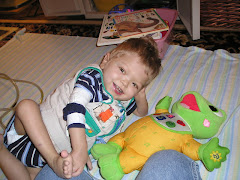
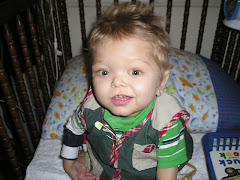
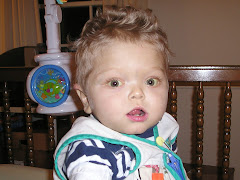
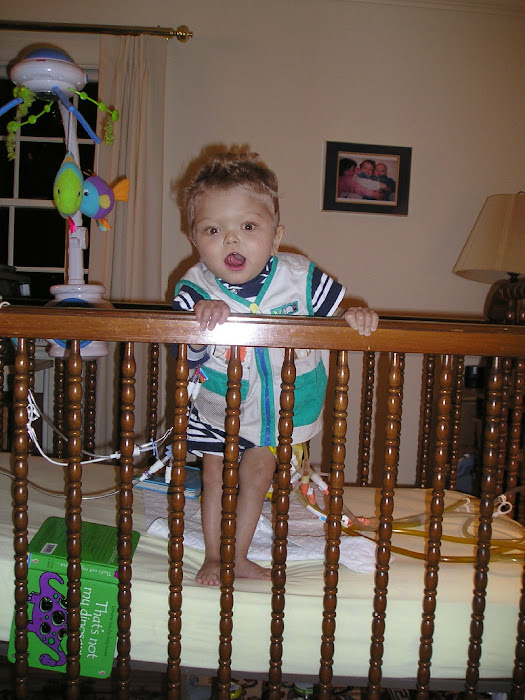
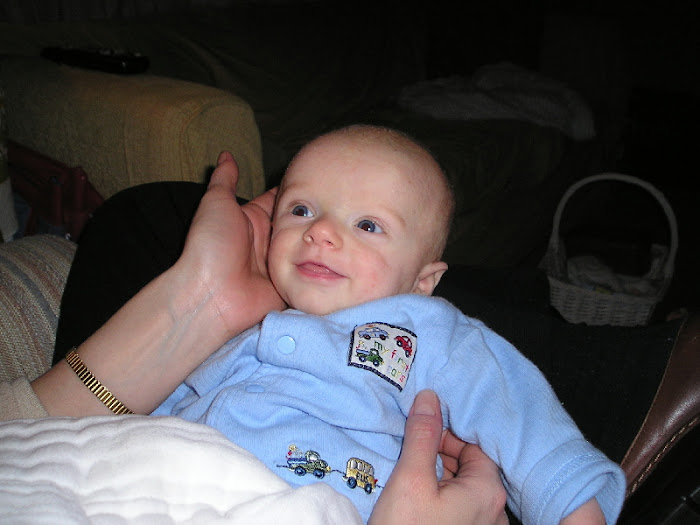
Peter has been getting up at night the past few weeks to ask for water and then to do the toddler-thing and refuse to go back to sleep. "Let me have the cup Peter." "NO." "Well, you need to lie down, Peter." "NO." "Yes, you do. Your diaper is wet and I need to change it." "NO." He protests very loudly at this point and I remind him that everyone is sleeping. "The trees are sleeping. Don't wake them up." "Flowers?" "Yes. The flowers are sleeping." "Kisty?" "Yes, Kristy is sleeping." "Pat?" "Yes, Pat is sleeping." And we go through the names of his nurses and therapists. The fact that he has woken up any family members doesn't faze him and we go on listing other people/things that are sleeping until he decides he can in fact let everyone/everything continue to sleep by being quiet and going back to sleep himself.
Last night was a particularly long night of protests. To try to emphasize my point that it was time to sleep and he needed to settle down, I looked at him face to face and then went on further to talk about the animals he was keeping up. "The birds are sleeping, Peter. And the dogs." "Bees?" Surprised he made the leap to animals with me, I said, "Yes, the bees too." "Turtles?" "Yes, the turtles too." Now I am just amazed that he is going on this tangent with me and listing just animals. "Giraffes?" "Yes, giraffes are sleeping." Peter growls. "Yes, the lions are sleeping too." After he gives a lower growl I tell him, "Yes, the bears are asleep too. Now you go to sleep Peter." "NO." Ahhh, the great discoveries and trials of toddlerhood!
Tuesday, May 27, 2008


Thursday, May 22, 2008
Mystery CRP, walking and talking

Peter's CRP has been elevated for the last month. It began to go up the last time Peter was ill - when we discovered what we think is a connection between enteral flagyl and his last 3 bouts of illness. No one yet seems to know what to make of it, but it is not going down. Peter has not grown anything from culture, doesn't act in the least bit ill, and temps have been good. The rest of his labs have been stable too. In fact, the last set of bilis went down again. Unfortunately, the CRP elevation still leaves us unable to test his bowel with feeds, as it could be an irritated bowel causing the CRP elevation and we don't want to stress things further. The bouts of illness also coincided with the increased clamping times of his G-tube as well as with the enteral flagyl, which we stopped at the same time we took away the enteral flagyl. We don't really know which caused Peter to become ill each time. I am voting for flagyl since that would be a simpler answer. But since we don't know and CRP is still up, no clamping, no formula feeds, no real testing of the bowel's function. We may have to wait for more hospital tests to be performed when Peter goes to Boston again before we can move on testing the bowel function.
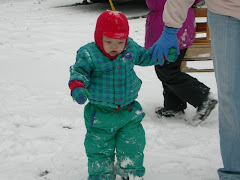
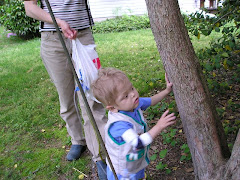
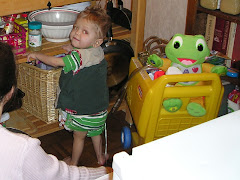
Meanwhile, our little guy is learning to walk solo. He is just doing solo steps in spurts, but he is doing it. He gets scared to hold onto nothing though. It takes a good amount of coaxing until he practices several times going back and forth between a person and the couch. When he walks around the house though, he is barely holding on to one finger of one hand of the person walking with him. He really doesn't need the support much at all. The little car walker is really only for outdoors now, as he has gotten so stable walking indoors holding a finger.
AND our champ is beginning to talk! Speech came to see him after a month, and she was thrilled with how much he is speaking now. We had been trying to use a combination of sign language, picture communication book, and speech for the last few months. This last couple of weeks Peter has been repeating what he is asked to say (with some toddler variations in the way the words come out of course). He is FINALLY saying the word "NO," and I have never been so excited to hear a toddler say no. "Peter, we need to change your diaper." "NO." There are pros and cons of course to a toddler who can communicate that he does not agree with your plan, but better he say no than just yell about it. The hard part is not smiling when he so cutely says "NO." I don't want to encourage that too much!
Wednesday, April 30, 2008
So what did Dr. Flake say?
While we were at CHOP two weeks ago inpatient, the GI doctor there felt that the best way for us to get Peter's bowel up and going is to surgically put it back together. That would give it the best shot at showing us how functional it is. Dr. Kamin has said the same. Sounds simple. Dr. Kim has told us that Peter's bowel may never be able to be surgically closed as of our last trip to Boston in February. However, Dr. Kim encouraged us to get another opinion, as someone else may see an option that he doesn't. So while we were at CHOP, Dr. Flake did come to see Peter and me. The bottom line is that he also feels Peter is a tremendous surgical risk and that his option is really only transplant at this time. Risks include: portal hypertension (bleeding risk during and after surgery, and possible poor healing from altered cirulation), increased coagulation times (bleeding risks again), ascites (poor healing and fragile bowel tissue), prior surgical scarring of the bowel (adhesions in the bowel that would be stronger than the bowel itself, lending the bowel to tearing when trying to separate the adhesions), as well as the facts that we don't know if the bowel actually works, and that we still may end up needing a liver tranpslant down the road if the liver truly isn't much better than it was. Finally, Peter has to heal from what Dr. Flake felt would be multiple risky operations. He said he has people with healthy bowel develop fistulas after bowel surgery and worries that Peter would only develop more fistulas with surgery. A transplant would give him a whole new bowel, new liver, and remove the portal hypertension because his portal vein and clot would leave with his liver and be replaced with the new liver and its circulatory veins and arteries.
Not the answers we were hoping for, and Dr. Flake apologized that he couldn't give us the non-transplant answer that we wanted. So we are planning to seek the advice of a third surgeon who works with Dr. Puder who is the Omegaven doctor at CHB. We would plan to see him the next time we are up in Boston. That will give us time for the TPN nutrition changes to kick in and maybe even to begin testing the bowel a bit more. If he also says there is no other option, then that is our answer. But he may see things differently, as he has for two other short-gut children that we are aware of. Dr. Kamin reminds us that Peter is doing things now that have not been done - kids as sick as Peter have either gone on to transplant or died, not acted better and better, and not improved by labs and examination. So he may still surprise us with the improved TPN nutrition and drop the ascites, may continue to lower the coagulation numbers (last INR was 1.3), and may have a healthier bowel with the improved nutrition. Portal hypertension may still be of concern with operating, or maybe there is something we can do to assist with that risk as well.
Everything has some big risks - surgery to put the bowel together, transplant and post-transplant living, staying on TPN, having portal hypertension, having a central line (the PICC line). Once we get our third opinion, then I guess we weigh the risks and try to choose to keep trying to rehab the bowel or to transplant. Or we may not have a choice... but we feel that we would be fine with that too. We have been praying for direction and patience while we wait to see which way his bowel and liver and surgical opinions go. We are always grateful for Peter's smiles and playfulness... which have been more abundant than ever. Maybe that is God's way of giving us patience - having Peter show us that he is content and patient, and we should be too.
Not the answers we were hoping for, and Dr. Flake apologized that he couldn't give us the non-transplant answer that we wanted. So we are planning to seek the advice of a third surgeon who works with Dr. Puder who is the Omegaven doctor at CHB. We would plan to see him the next time we are up in Boston. That will give us time for the TPN nutrition changes to kick in and maybe even to begin testing the bowel a bit more. If he also says there is no other option, then that is our answer. But he may see things differently, as he has for two other short-gut children that we are aware of. Dr. Kamin reminds us that Peter is doing things now that have not been done - kids as sick as Peter have either gone on to transplant or died, not acted better and better, and not improved by labs and examination. So he may still surprise us with the improved TPN nutrition and drop the ascites, may continue to lower the coagulation numbers (last INR was 1.3), and may have a healthier bowel with the improved nutrition. Portal hypertension may still be of concern with operating, or maybe there is something we can do to assist with that risk as well.
Everything has some big risks - surgery to put the bowel together, transplant and post-transplant living, staying on TPN, having portal hypertension, having a central line (the PICC line). Once we get our third opinion, then I guess we weigh the risks and try to choose to keep trying to rehab the bowel or to transplant. Or we may not have a choice... but we feel that we would be fine with that too. We have been praying for direction and patience while we wait to see which way his bowel and liver and surgical opinions go. We are always grateful for Peter's smiles and playfulness... which have been more abundant than ever. Maybe that is God's way of giving us patience - having Peter show us that he is content and patient, and we should be too.
Keeping us guessing
Peter had ANOTHER mystery illness with low-grade fever, nausea, abdominal tenderness, fluid gain, increased respiratations and heartrate, and grunting respirations. And again it was the weekend... at night. And then the idea struck that perhaps these mystery illnesses have something in common. Peter has not been ill in so long, and then three times in less than two months?! Looking back through notes there are two things that seem in common as possible causes - enteral flagyl or the more lengthy time spent with the G-tube clamped off. So, we stopped both, and Peter pulled right on out of the illness within 24 hours after stopping both things. On Monday's routine lab draw, his numbers all look good, except for the C-reactive protein (CRP) which went really high and is a marker of inflammation or infection, but is non-specific. We got cultures drawn from the PICC and urine (done at home, to our great relief), but he is still acting well since our Friday illness, so the CRP may mean he picked up a virus, or that the possible allergy also caused inflammation, or somthing else... but if he is acting well nothing to worry about, unless it keeps rising in subsequent labs.
The enteral flagyl was to treat bacterial overgrowth in his gut which is a common issue in kids that aren't eating. We will switch back to cipro again, every 3 weeks for a week via G-tube. He has tolerated that well in the past.
We will also hold off on clamping the G-tube again for another week or two until we feel certain Peter is not ill by labs and behavior and time. So, still no enteral feeds and now no clamping. Not making much progress in the enteral department this way, but it would be hard to decide if he is having intolerance to feeds or to clamping if we threw that into the picture and he started acting ill again.
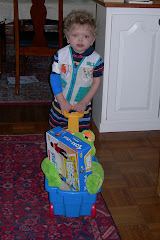
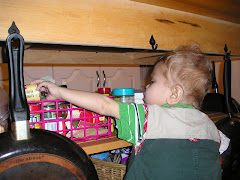
He seems to be liking the extra protein and calories in the TPN. Weight is still down, but his energy is definitely up. He keeps wanting to walk with his "car" walker from room to room, pausing to look in the refrigerator, kitchen cabinets, and to smell almost every spice that we have... several times a day. And, he pauses to look at his reflection as he walks past the stove and the dishwasher, with a gigantic grin of well-deserved satisfaction.

Peter's walker, "car"

In the kitchen
The enteral flagyl was to treat bacterial overgrowth in his gut which is a common issue in kids that aren't eating. We will switch back to cipro again, every 3 weeks for a week via G-tube. He has tolerated that well in the past.
We will also hold off on clamping the G-tube again for another week or two until we feel certain Peter is not ill by labs and behavior and time. So, still no enteral feeds and now no clamping. Not making much progress in the enteral department this way, but it would be hard to decide if he is having intolerance to feeds or to clamping if we threw that into the picture and he started acting ill again.
He seems to be liking the extra protein and calories in the TPN. Weight is still down, but his energy is definitely up. He keeps wanting to walk with his "car" walker from room to room, pausing to look in the refrigerator, kitchen cabinets, and to smell almost every spice that we have... several times a day. And, he pauses to look at his reflection as he walks past the stove and the dishwasher, with a gigantic grin of well-deserved satisfaction.

Peter's walker, "car"

In the kitchen
Friday, April 18, 2008
In and out of CHOP again
We had another unexpected admission to CHOP last week. Peter was fussy, temp on/off, and then began vomiting. If you get a fever with a central line, it pretty much automatically means that you need to obtain blood cultures and begin antibiotics for at least 48 hours. If nothing grows out of the culture, antibiotics can be stopped. Last time Peter continued antibiotics without anything growing because it was possible he had a pocket of infected fluid. This time though, he had been exposed to a cold, strep throat, and a GI bug with vomiting. After nothing grew out of the cultures, he was taken off antibiotics and sent home, looking pretty good for a kid who three days before was vomiting and two days before slept almost the whole day and had started retaining fluid. Peter almost always retains fluid when he gets hit with a virus or bacterial infection.
The good that came out of the admission was that we had a very astute GI attending (the director of the GI dept) who saw beyond the current illness and began discussions with our Boston team about Peter's overall illness and progress. This has helped us in the reevaluation of his TPN nutrition, which always seems to be such a delicate balancing act. Peter's liver numbers are good enough that there has been some question if he is actually getting enough protein, even though by the books he is receiving a huge amount. We are going to go ahead and try making some big changes, increasing his protein and increasing his calories by quite a bit, which hopefully will boost his energy and reduce the ascities. We have our fingers crossed. It seems worth a try, and if Peter can't handle it, then we can always go back down on the protein. Dr. Kamin is in complete agreement, and I think is glad to have another GI who also feels that Peter may need more protein, whether "the books" say he is getting enough or not.
We also met with Peter's CHOP surgeon, Dr. Flake, and discussed Peter's surgical issues with him. That is for another post, but the meeting was sincere and was actually suggested by Dr. Kim the last time we were in Boston. So, I must say, that as much as we always dislike an unexpected hospitalization, especially if Peter is acting ill, the admission gave us the opportunity to discover and address some needed tweaking in Peter's care.
The good that came out of the admission was that we had a very astute GI attending (the director of the GI dept) who saw beyond the current illness and began discussions with our Boston team about Peter's overall illness and progress. This has helped us in the reevaluation of his TPN nutrition, which always seems to be such a delicate balancing act. Peter's liver numbers are good enough that there has been some question if he is actually getting enough protein, even though by the books he is receiving a huge amount. We are going to go ahead and try making some big changes, increasing his protein and increasing his calories by quite a bit, which hopefully will boost his energy and reduce the ascities. We have our fingers crossed. It seems worth a try, and if Peter can't handle it, then we can always go back down on the protein. Dr. Kamin is in complete agreement, and I think is glad to have another GI who also feels that Peter may need more protein, whether "the books" say he is getting enough or not.
We also met with Peter's CHOP surgeon, Dr. Flake, and discussed Peter's surgical issues with him. That is for another post, but the meeting was sincere and was actually suggested by Dr. Kim the last time we were in Boston. So, I must say, that as much as we always dislike an unexpected hospitalization, especially if Peter is acting ill, the admission gave us the opportunity to discover and address some needed tweaking in Peter's care.
Subscribe to:
Posts (Atom)